
From Ceremony to Last Dance: Planning Your Wedding Day Music Timeline
Music isn’t just a one-time thing at a wedding – it’s a constant companion that shifts and changes to fit each part of the day. A bit of planning for your music timeline will ensure every moment, from “I do” to the final send-off, has the perfect soundtrack. Let’s walk through a typical wedding day and map out the music, shall we?
Ceremony:
We covered ceremony music in detail in another post, but to recap the timeline: you’ll have prelude music as guests are seated (gentle background tunes), then the processional (entry music for the bridal party and bride/groom), possibly a song during any unity rituals or signing, and a recessional (happy exit music). The key is to coordinate start/stop cues with your musicians or DJ so the transitions are smooth. Example: Prelude from 1:30–2:00pm, processional at 2:05pm when the aisle entry begins, recessional at ~2:30pm after the announcement of marriage. Once you outline it, communicate these rough times and cues to whoever is handling the music on the day.
The Laura Erby Duo - High Row’s Most-Booked Drinks Reception Act
Cocktail Hour (Drinks Reception):
After the ceremony, there’s usually a period for mingling, drinks, and canapés while you take photos. This is a great time for ambient music that sets a mood but doesn’t demand full attention. Popular options include a jazz trio or solo pianistfor classy vibes, a folk-acoustic duo for a laid-back feel, or even something fun like a roaming acoustic band singing upbeat tunes among guests. If live music isn’t in budget here, prepare a playlist of light, feel-good songs to play over the sound system. Think songs that encourage toe-tapping and conversation, not club-thumping beats. Timeline tip: If cocktail hour is say 1 hour around 3-4pm, aim for 15-20 songs in your playlist (or make sure the band has a set lasting that long). Keep the volume moderate so people can chat comfortably. This is also a chance to incorporate genres you love that might not appear later – e.g., classical, swing, or even cultural music aligning with your heritage. Couples often tell us that having gentle live music during cocktails really elevates the atmosphere, making it feel like a swanky event rather than just a wait for dinner to start.
Dinner (Wedding Breakfast):
During the meal, you might not initially think music is crucial, but it definitely contributes to the ambiance. You have two main choices: live background music or a curated dinner playlist. Some couples hire a solo musician (like a classical guitarist, harpist, or saxophonist) to play melodies while guests dine – it adds an elegant touch and keeps energy up softly. Others stick to a playlist of mellow tracks (soul, acoustic covers, jazz, etc.). Decide if you want pure background or some entertainment; just ensure it’s not too loud. People will be talking at their tables, so music should be audible yet subtle. Typically, dinner lasts 1-2 hours, so plan enough music to cover that duration. You can even break it into sections: lighter music at the start, maybe slightly more upbeat by dessert to gently energize people for what’s next (but still not dance music yet). Having live music accompany dinner is a trend for 2025–2026 as couples turn the meal into more of an experience – for instance, a singer might serenade the room briefly between courses or a quartet might play a special song during cake cutting. It’s certainly not required, but it can create a lovely soundtrack of your love playing throughout the meal.
(An aside: If you anticipate speeches during dinner, coordinate with your musicians/DJ to pause the music during toasts. And if the band needs to set up in the same room as dinner, plan either to have them set up before guests arrive or provide some gap/cover noise if they must set up during a turn-around.)
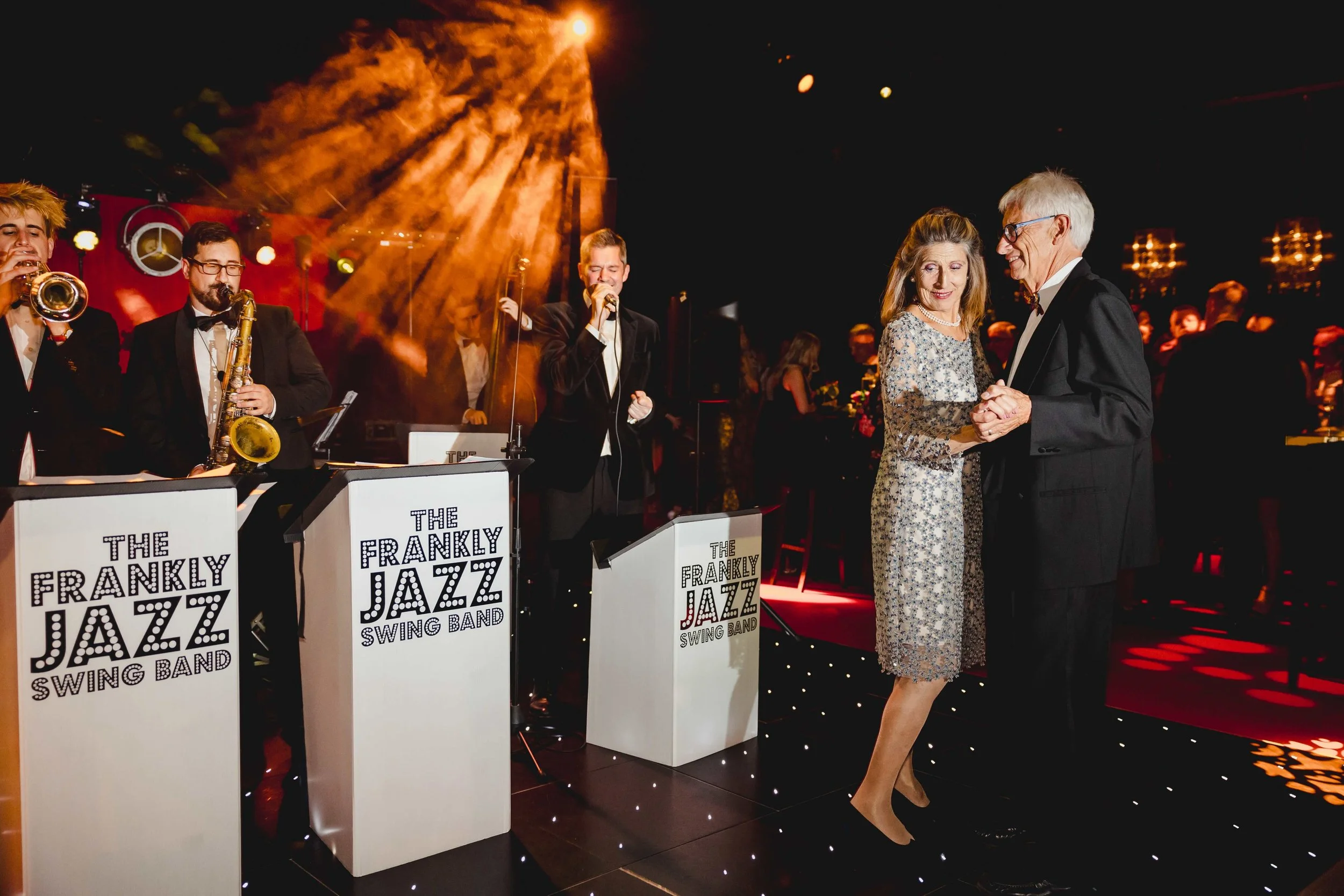
Frankly Jazz - High Row’s Most-Booked Big Swing Band
Grand Entrance & First Dance:
Often couples make a “grand entrance” into the reception (either into the dinner or into the room after dinner for dancing). Pick a high-energy song for when the MC/DJ announces you and you walk in as newlyweds to cheers. This can be anything – from “Celebration” by Kool & The Gang to “Bring Me Sunshine” – whatever puts you in a celebratory mood. It’s typically just a short snippet as you enter and perhaps go to your seats or straight into your first dance, depending on schedule. If you’re doing the first dance after dinner, coordinate when the song should start. For example, the DJ might announce: “And now the couple will have their first dance,” at which point your chosen song begins. Ensure the band/DJ knows your first dance song and has it ready (live band should ideally practice it and confirm the version with you). Right after the first dance, many couples segue into a parent dance (like father-daughter dance) – if so, have that song queued up next.
This part of the timeline is all about special dances. A sample timing could be: 7:00pm couple’s grand entrance to reception (1 minute of entrance song), then straight into cake cutting (with a background song), then first dance at 7:10pm (3-4 minutes), followed immediately by father-daughter dance (another 3 minutes). After that, the dance floor opens for everyone.
Dancing (Reception Party):
Now it’s party time! Once open dancing kicks off, you’ll usually have either your live band’s sets or your DJ’s playlisttaking center stage. A typical live band might do two sets (e.g., 8:00-9:00pm and 9:30-10:30pm) or even three shorter sets, with breaks in between. During breaks, plan for filler music so the energy doesn’t dip – a DJ can cover, or have a premade playlist of danceable songs to play through the PA. If you have a DJ for the whole night, they’ll likely go in continuous blocks or according to the schedule (perhaps ramping up as the night goes on).
For the music timeline, consider these phases:
Early Dancing: Right after the first dances, it can help to play a few older classics or ultra-popular tunes that get all generations up. (Think “September” by Earth, Wind & Fire or “Twist and Shout” – crowd pleasers.) This encourages everyone to join before the “late-night crew” takes over. Many times, older relatives might not stay super late, so play some of their favorites now so they can enjoy a dance or two.
Peak Hour: As the night progresses, lean into the songs you and your friends will freak out (in a good way) to. This is when your band or DJ can read the crowd and follow the vibe. If the ’90s bangers are killing it, keep ’em coming; if guests respond better to current chart hits, go that route. A good DJ/band will naturally adjust, but do give them guidance in advance on your must-play list (and do-not-play list!). For example, you might say: “We absolutely want ‘Mr. Brightside’ played – ideally near the end when everyone’s had a few!” or “We’d love some Bollywood tracks sprinkled in for my side of the family around 9pm, when the dance floor is warm.”
Late-Night Wind Down or Ramp Up: Check your venue’s end time and noise policy. If music has to end by say 11:00pm, plan a “last song” around 10:55 that’s a grand finale. Often couples choose a sentimental sing-along or a high-energy capper. If you can go late into the night (and have a crowd that will last), you might consider switching vibes later – e.g., after 11:30pm, the DJ could switch to more clubby tracks for the younger crew, or you could even transition to a silent disco as an after-party (no noise issues and a ton of fun – see the “unique ideas” post!).
Key Transitions to Plan:
Between Band Sets: If you have a band, decide what happens when they take a break. Many bands provide a DJ-style playlist in their downtime. Confirm that with them. If not, prepare an upbeat playlist on an iPod and have someone ready to hit play. You don’t want the vibe to fizzle out the moment the band stops. Even just background dance music keeps people in party mode (and might be when folks head to the bar or restroom, which is fine).
Special Moments: Will you do a bouquet toss or garter toss? If yes, pick songs for those (e.g., “Single Ladies”for bouquet toss is a classic choice). Plan them into the timeline – often after some dancing, you pause for these activities. Let your DJ/band know the cue. Same for other events like a money dance, anniversary dance, or any cultural dances. Put them on the schedule with approximate times.
Announcements: If you want to announce cake cutting or last call or sparkler send-off, coordinate with the music. The DJ/band can lower volume at a certain time and make the announcement, or have your MC do it. E.g., at 10:45pm music softens and MC: “Last song in 15 minutes – be sure to grab your partner for a finale!”
Sample Music Timeline: (just to visualize)
1:30pm – Prelude music as guests arrive at church.
2:00pm – Processional: Bridal party enters to “Canon in D”, Bride enters to “Can’t Help Falling in Love” (string quartet).
2:30pm – Recessional: Couple exits to “All You Need Is Love” (quartet leads guests out).
3:30pm – Cocktail hour with jazz trio playing upbeat swing tunes.
5:00pm – Reception entrance: Wedding party enters to “Uptown Funk”, couple enters to “You Make My Dreams”by Hall & Oates (DJ playing).
5:10pm – First dance: “Perfect” by Ed Sheeran (performed live by band’s singer or played by DJ).
5:15pm – Father-Daughter dance: “My Girl”. Mother-Son dance: “What a Wonderful World”. (Band plays these live).
5:20pm – Dinner begins; playlist of soft indie songs plays in background via speakers.
7:00pm – Toasts (no music during speeches).
7:30pm – Cake cutting: Play “How Sweet It Is (To Be Loved by You)” softly in background for atmosphere.
7:45pm – Dance floor opens. Band Set 1: Kicks off with “September” to get everyone up.
8:30pm – Band takes a break. DJ plays a mix of pop hits (or band’s pre-made playlist) for 15 minutes.
8:45pm – Band Set 2: More high-energy songs from 8:45 to 9:30.
9:30pm – Bouquet Toss: DJ plays “Single Ladies” for bouquet toss. Garter toss: “Let’s Get It On” snippet for laughs.
9:35pm – DJ resumes for open dancing with some club tracks requested by friends. Or Band Set 3 if band does another.
10:55pm – Last song: “Don’t Stop Believin’” – everyone sings along in a big circle.
11:00pm – Music off, guests line up for sparkler exit (perhaps an acoustic guitar quietly plays outside as a nice touch, or no music needed).
Of course, your timeline may differ (afternoon wedding, etc.), but the idea is to map out who plays what when. Share this with your vendors: band, DJ, venue coordinator, etc., so everyone knows the plan.
Stay Flexible: Weddings rarely run exactly on time, but having this framework means you can easily adjust. If dinner runs long, maybe you shorten the band’s first set a bit, etc. Communicate with your DJ/band leader – they’re usually pros at adapting their set lengths to the flow (“Do you want one long set or two short? Are we cutting the bouquet toss? Let’s adjust the playlist.”).
Remember the Goal: Each segment’s music should complement the mood: serene during ceremony, relaxed during dinner, and rockin’ during dancing. By thinking through the whole day’s soundtrack, you’ll avoid lulls and awkward silences, and you’ll maximize those wow moments when the right song at the right time gives everyone the feels.
Finally, once the day comes, trust the groundwork you’ve laid and then let go and enjoy each moment! Don’t fret if the timeline shifts a bit – your vendors will handle it. You’ll be too busy twirling on the dance floor to notice that the cake cutting song started 5 minutes later than planned. 😉 With a little planning, the music will flow seamlessly from ceremony to last dance, keeping you and your guests in the perfect spirit all day long.
(Source: Couples increasingly opt for all-day musical experiences, from acoustic during cocktails to full-band reception sets. Make sure to arrange continuous music even during band breaks to keep the energy up.)